

Our story

Why
HutEleven?

Our name comes from one of the most famous code-breaking rooms in history. It’s a reminder of what we do every day: take something complicated and make it simple.

Hut 11 · Bletchley ParkBedford · Bedfordshire

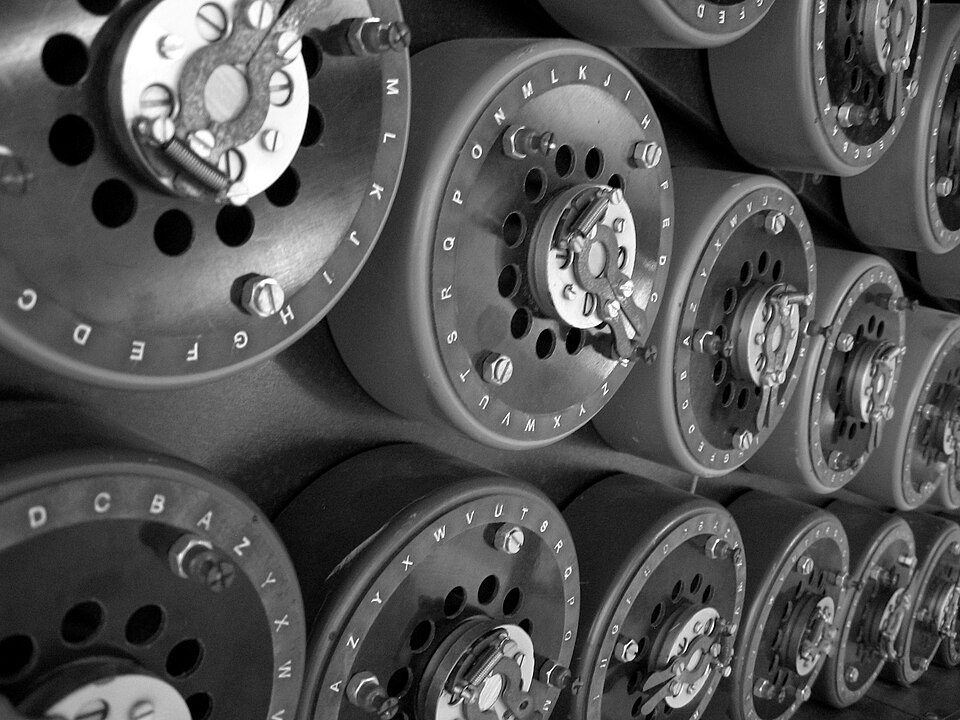
Photo: Marcin Wichary, CC BY 2.0, converted to black and white

Rows of drums on a rebuilt Bombe
1941The Bombes move to Hut 11
14 March 1940The first Bombe, ‘Victory’, starts work in half of Hut 1
15 × 12 ftThe room the whole unit shared, with the sick bay next door
March 1941The Bombes move into Hut 11, the Park’s first brick building
16Bombes at work by the end of 1941, six of them in Hut 11
How we got our name

A Father’s Day Trip
to Bletchley Park.

Our job is to decode the complexity of cloud and communication services for schools and businesses. So we got thinking: what do we use to decode things every day? Our brains. A lock and key. A computer…

The answer came on a Father’s Day trip to Bletchley Park. Between rounds of Tetris and Space Invaders in the computer museum (who could resist?), we found ourselves in the story of the Bombe: the machine that helped crack the German Enigma code.

The Bombe Project started in 1940 with just three people. Alan Turing, a Cambridge mathematician, came up with the original idea: a machine that could work out Enigma’s settings far faster than anyone could by hand.

The first Bombe, optimistically named ‘Victory’, started work on 14 March 1940 in half of Hut 1. The other half was the sick bay. Hmm… sterile. The whole unit was squeezed into a room 15 feet by 12 feet, which sometimes doubled as the dining room and sleeping quarters.

In March 1941 the Bombes moved into Hut 11, the first brick building at Bletchley Park. As more machines arrived, new stations opened nearby at Adstock and Wavendon. By the end of 1941 there were 16 Bombes at work, six of them in Hut 11.

Then vs now

A Daily Race Against the Clock

Every day the codebreakers had to find a brand new key: the wheel order, the wheel settings and the plugboard. The Army and Air Force picked three wheels from a set of five. The Navy chose from eight.

3–5,000Enigma messages intercepted each day
2–4 hrsfor some keys to be broken
211Bombe machines built
1,676Wrens involved, plus 263 RAF personnel
The Bombe’s clever trick

Enigma had one flaw: a letter could never be enciphered as itself. The codebreakers used ‘cribs’, words they expected to find in a message, and the Bombe raced through the settings looking for ones that fitted, ruling out the rest.

1 tonthe weight of a single Bombe
Up to 6Bombes working side by side in Hut 11
12 milesof insulated wire inside
13 minutesAnd today? In 2017, 2,000 cloud servers cracked an Enigma message in just 13 minutes, checking 41 million combinations every second.
Facts from The National Museum of Computing and Bletchley Park.
Plan a visit to Bletchley Park We highly recommend it!
Try it

Crack the Code.

The Bombe raced through rotor settings to find each day’s Enigma key. Turn the three drums to find ours, or let the machine do the work.

AAA
Drum 1
AAA
Drum 2
AAA
Drum 3
Hint: the key spells out where the Bombes lived.A simplified game inspired by the Bombe. The real machine weighed a ton, with rows of drums standing in for Enigma’s rotors and 12 miles of wire, and was run by teams of Wrens.
What we stand for

Four Values.
No Jargon.

01
Clarity
Making telecoms simple and accessible.

Plain English, every time. You’ll always know what you have, what you’re paying for and why.

Your Trusted Telecoms Partner.

Plain English

We explain every option so you can decide with confidence.

Tailored, not boxed

Our engineers build around your needs, not a package.

Real people

A local Bedford team you can pick up the phone to.

Got a Problem
to Crack?

Get in touch